When Solidarity Becomes a Crime: Australia’s Test of Democracy in the Face of Pro-Palestine Protests
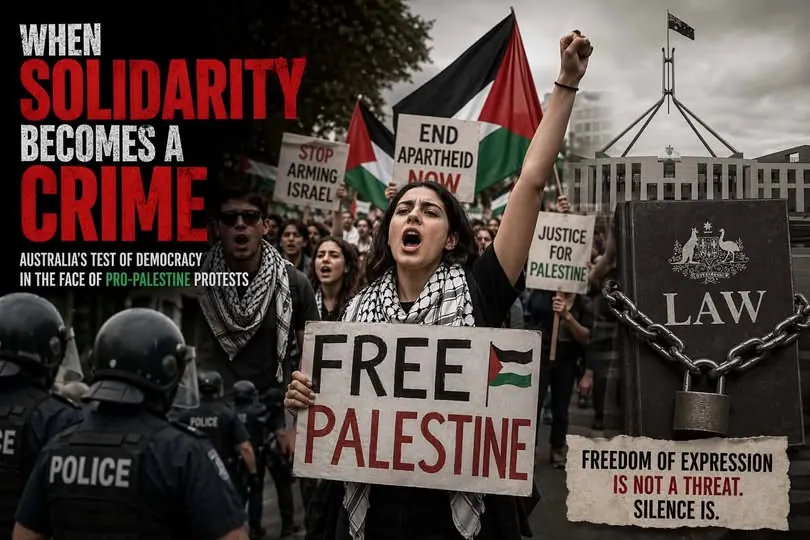
When Solidarity Becomes a Crime: Australia’s Test of Democracy in the Face of Pro-Palestine Protests
22 APRIL 2026
By Khaled Ghannam
Australia has recently witnessed a marked escalation in political and legal debates over the limits of freedom of expression and the right to protest, amid a growing wave of public solidarity with the Palestinian people. The prosecution of protesters for raising pro-Palestine slogans has sparked widespread concern within human rights circles, which view these measures as a troubling indication of shrinking democratic space and a return to historical periods marked by restrictions on civil liberties, such as those seen in Queensland during the 1970s. This situation reflects a growing tension between the state and civic movements, raising a fundamental question about the extent to which the government is committed to protecting freedom of opinion on sensitive international issues.
On the other hand, popular voices in support of Palestine have not retreated. Instead, Australian cities have witnessed mass protests, particularly during symbolic occasions such as Palestinian Prisoners’ Day. Participants have called for a reassessment of Australia’s political and military relations with Israel, arguing that these ties contradict the values Australia publicly claims to uphold regarding human rights. Protesters have expressed concern over attempts to restrict their right to peaceful expression, insisting that solidarity with justice causes should not be criminalised or curtailed under any legal pretext.
On the legal front, significant developments have emerged, including the overturning of certain laws described as restrictive to the right to protest—an outcome widely regarded as an important victory for civil society. Human rights organisations, including Amnesty International Australia, have welcomed these rulings, emphasising the judiciary’s crucial role in safeguarding fundamental rights. These organisations have also stressed that anti-hate legislation must not become a tool for criminalising peaceful political activity or silencing voices critical of state policy and international alignments.
At the same time, activists and legal organisations are preparing to challenge new hate speech laws, which they describe as overly broad and designed in a way that risks suppressing legitimate political expression. From this perspective, such laws reflect a deeper structural tendency: the use of legal frameworks to manage dissent rather than protect it. Critics argue that when laws are shaped in a climate of political pressure, they risk becoming instruments of control rather than safeguards of freedom. The real democratic test, therefore, lies in whether societies protect dissenting political speech—even when it challenges powerful state alliances.
The movement has extended beyond the streets and courts into foreign policy scrutiny, with human rights groups filing legal challenges against Australian arms exports to Israel. They argue that the continuation of these exports may contradict Australia’s obligations under international humanitarian law. From a socialist and anti-imperialist standpoint, these legal challenges highlight a deeper contradiction: the alignment of state policy with military-industrial interests and strategic alliances, even when such policies are seen to enable or sustain systematic violence against civilian populations.
In parallel, there are also more radical left-wing activists who reject compliance with existing laws, including a proportion of Jewish communist activists. They organise protests outside government buildings and offices of the Australian Labor Party, demanding justice for Palestine and calling on the Australian government to sever ties with the Israeli government, which they accuse of genocide in Palestine. From their perspective, the state is not a neutral arbiter but an active participant in maintaining global systems of oppression, and protest becomes a necessary tool of resistance rather than a symbolic act.
In a related context, the detention of Palestinians arriving from the Gaza Strip at the Villawood Immigration Detention Centre in Sydney has emerged as one of the most contentious humanitarian issues. Reports regarding the detention of individuals, including Mohammad Al-Masri and Nasser Abu Shatatt, have raised serious questions about the compatibility of these measures with refugee protection principles, particularly given that they fled extremely harsh humanitarian conditions caused by war. Human rights advocates argue that placing them in high-security detention centres, rather than adopting humane alternatives such as community placement, reflects a punitive and securitised approach to migration that dehumanises displaced people. Activists further suggest that these cases reflect a broader systemic pattern in immigration policy, where refugees are processed through a security framework rather than a humanitarian one, reinforcing exclusion rather than protection. Even basic rights such as family reunification applications or marriage procedures remain inaccessible for arrivals from Gaza, raising serious concerns about decisions made by the Minister for Immigration regarding those fleeing the war on Gaza.
Meanwhile, Australia has seen increasing protests opposing wars in the region, including military escalation in Lebanon and Iran. Crowds in several cities have called for an end to military operations and rejected any Australian involvement in these conflicts. These movements have urged a political shift away from militarised foreign policy and toward de-escalation, diplomacy, and an end to complicity in regional violence. They warn that continued alignment with military escalation risks expanding the conflict and deepening humanitarian catastrophe across the region.
Taken together, these developments place Australia before a genuine test of how it balances security and civil liberties. Freedom of expression and the right to protest are not privileges granted or withdrawn according to political convenience; they are hard-won rights achieved through struggle, and they remain constantly threatened by state power when it seeks to discipline dissent. From a socialist and anti-imperialist perspective, the current moment exposes a deeper contradiction within the system itself: a state that publicly celebrates democracy while simultaneously constraining political expression, protecting strategic alliances over human rights, and managing dissent through law, policing, and selective enforcement. The challenge is not merely legal—it is . structural, and it demands a reorientation of policy toward genuine democratic accountability, social justice, and solidarity with oppressed peoples rather than alignment with power