The U.S.–Israeli War on Iran: A Struggle for Hegemony and Regional Disintegration
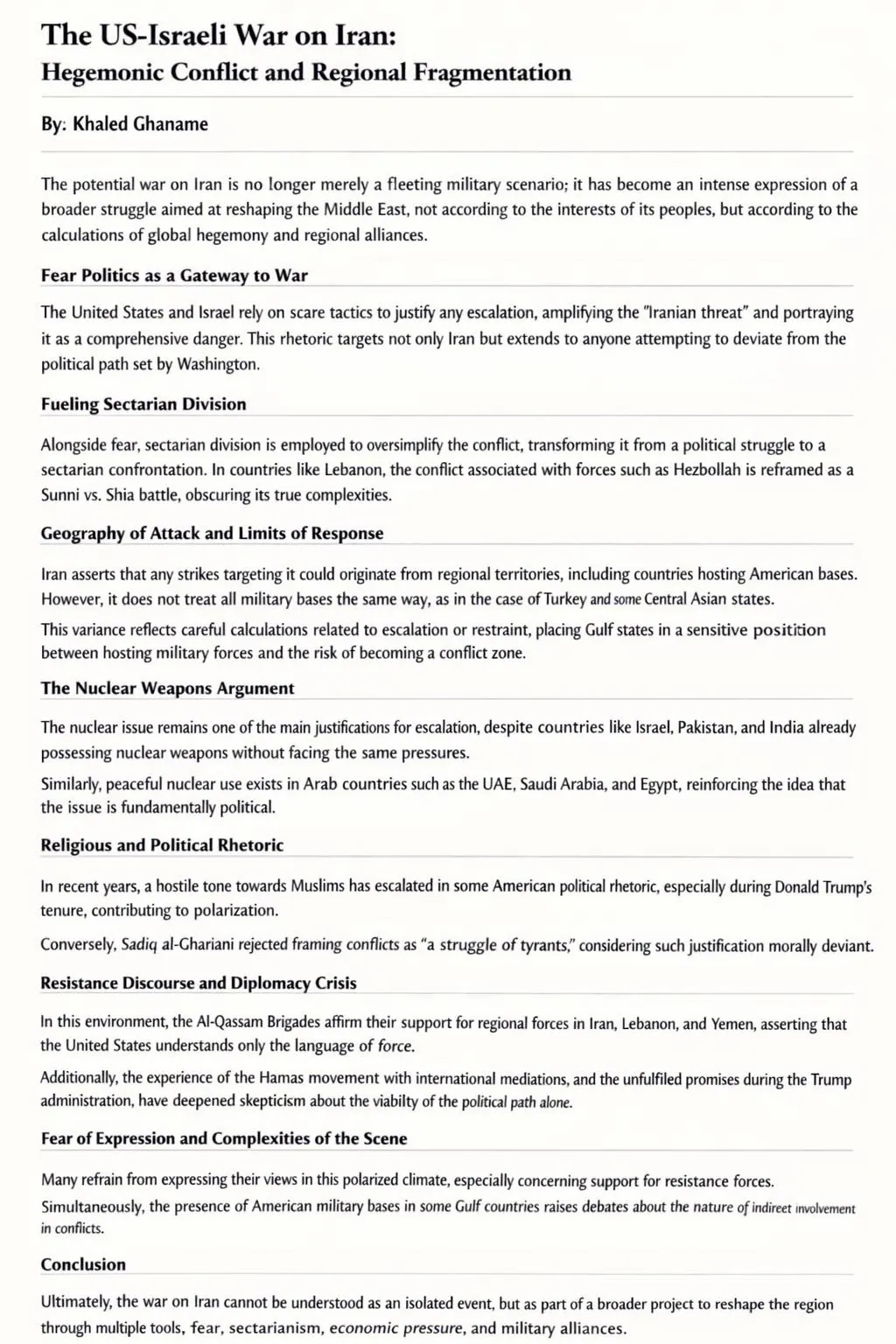
The U.S.–Israeli War on Iran: A Struggle for Hegemony and Regional Disintegration
7 APRIL 2026
By: Khaled Ghannam
The potential war on Iran is no longer a mere military scenario; it has become a concentrated expression of a broader struggle over reshaping the Middle East—not according to the interests of its peoples, but according to calculations of international hegemony and regional alliances.
Fear as an Entry Point to War
The United States and Israel rely on a rhetoric of fear to justify any escalation, exaggerating the “Iranian threat” and portraying it as an all-encompassing danger. This discourse does not only target Iran but extends to anyone attempting to deviate from the political path outlined by Washington.
In this context, this policy intersects with the positions of some Gulf states, which see their alliance with the U.S. as a guarantee of security and stability, even if it comes at the expense of independent political decision-making.
Fueling Sectarian Division
Alongside fear, sectarian division is exploited to simplify the conflict and transform it from a political struggle into a religious confrontation. In countries like Lebanon, the conflict involving forces such as Hezbollah is often presented as a Sunni-Shia struggle, rather than understood in its true complexity.
In Syria, the regime’s positions reflect political pragmatism that goes beyond traditional alliances, while in Iraq, internal divisions between Iran-aligned forces and those closer to the Gulf exacerbate the fragility of the state.
Geography of Attack and Limits of Retaliation
Iran asserts that any strikes against it could originate from regional spaces, including countries hosting U.S. bases. However, it does not treat all military bases with the same logic, as seen in the cases of Turkey and some Central Asian countries.
This variation reflects precise calculations regarding the expansion or containment of escalation, placing Gulf states in a sensitive position between hosting foreign military forces and the risk of becoming a battlefield.
The Nuclear Argument
The nuclear file remains one of the most prominent justifications for escalation, even though countries like Israel, Pakistan, and India already possess nuclear weapons without facing the same pressures.
Peaceful nuclear use also exists in Arab countries such as the UAE, Saudi Arabia, and Egypt, reinforcing the idea that the issue is primarily political.
Some argue that the pressures—especially during Donald Trump’s administration—were also linked to attempts to economically integrate Iran under terms that favor American companies.
Religious and Political Discourse
In recent years, a hostile tone toward Muslims has intensified in some U.S. political discourse, particularly during Trump’s tenure, contributing to polarization.
In contrast, Al-Sadiq Al-Ghariani rejected justifying conflicts by the logic of “the struggle of oppressors,” considering it a moral deviation, reflecting religious positions that oppose politicizing conflicts in this way.
Resistance Rhetoric and Diplomatic Distrust
In this climate, the Al-Qassam Brigades emphasize their support for regional forces in Iran, Lebanon, and Yemen, considering that the United States only understands the language of force.
Additionally, Hamas’s experience with international mediation, and the unfulfilled promises during Trump’s administration, deepened skepticism about the effectiveness of a purely political track.
Fear of Expression and the Complexity of the Situation
Many hesitate to express their positions amid such polarization, especially regarding support for resistance forces. At the same time, the presence of U.S. military bases in some Gulf states raises debates about the nature of indirect involvement in conflicts.
Yet, despite all this, targeting civilians and infrastructure remains extremely sensitive under international law, setting boundaries that cannot be crossed without severe consequences.
Iranian Opposition and the Disappointment of Alliances
Even within Iranian opposition ranks, there is no consensus on supporting war. Some believe that the United States is not serious about changing the regime and acts solely according to its own interests.
Regional experiences, including those related to forces linked to the Kurdistan Workers’ Party, reinforced the feeling that allies could be abandoned at any moment, prompting some opposition figures to reevaluate their positions.
This experience feeds a widespread conviction that major powers—particularly the United States—deal with the region according to shifting interests, not fixed alliances. Hence, any temporary convergence of interests does not imply a long-term commitment to supporting local allies.
Conclusion
Ultimately, the war on Iran cannot be understood as an isolated event but as part of a broader project to reshape the region using multiple tools: fear, sectarianism, economic pressure, and military alliances.
Yet the clearest truth remains that these conflicts, regardless of their slogans, are managed according to interests rather than principles, and it is the people who ultimately pay the price.