In Australia: Has Saying “I Am Palestinian” Become an Accusation?
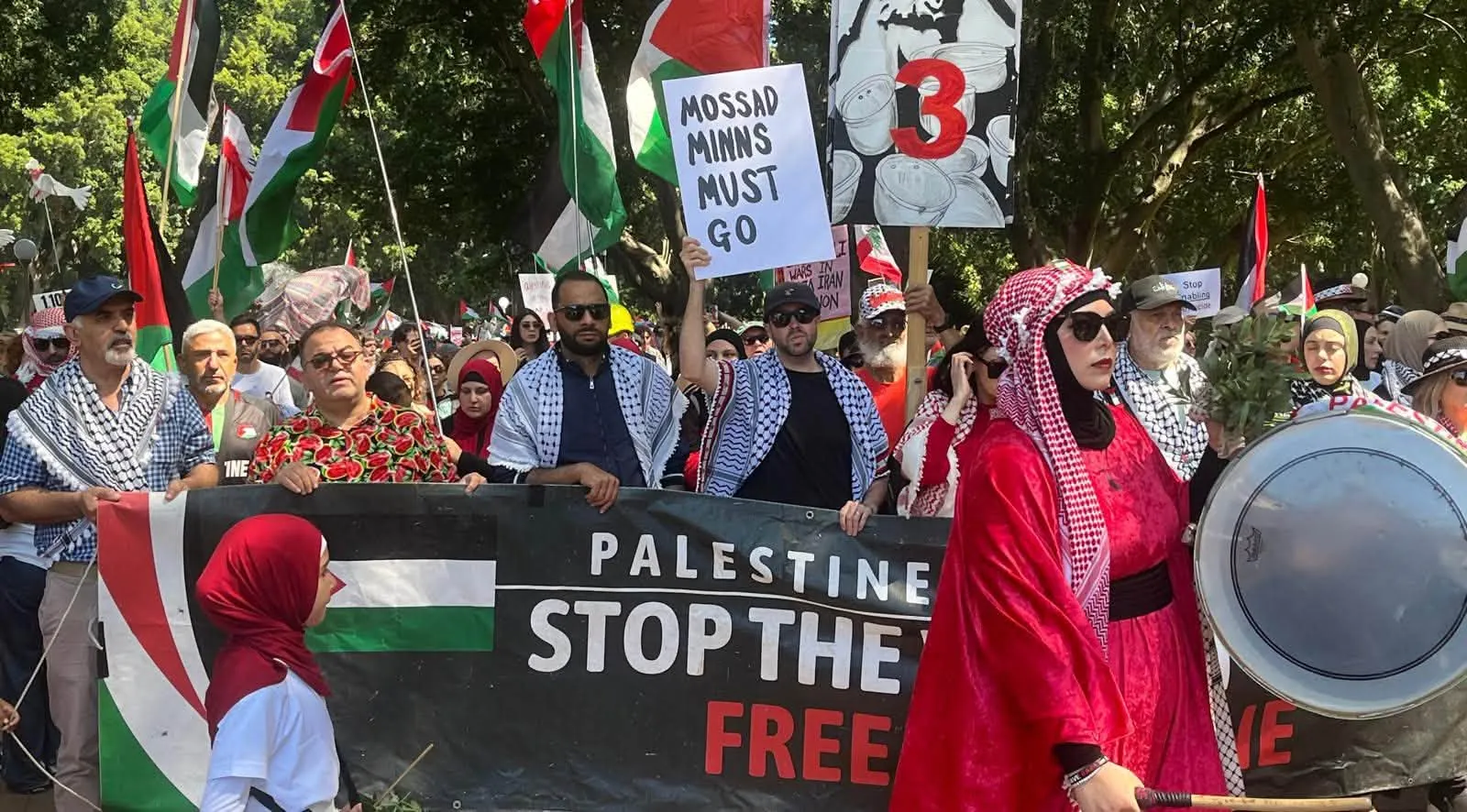
In Australia: Has Saying “I Am Palestinian” Become an Accusation?
Between terrorism laws, resistance to occupation, antisemitism legislation, restrictions on protest, and recognition of Palestine — what does it mean to be Palestinian in Australia today?
By Khaled Ghannam – Australia
Al-Intilaqah Centre for Studies – 2026
“If loving Palestine is a crime, then I am the biggest criminal in the world.”
These words are not a legal argument. They are a question.
What does it mean to be Palestinian in Australia today?
Does identifying as Palestinian, supporting Palestinian rights, opposing the occupation, participating in demonstrations, displaying the Palestinian flag, or calling for Palestinian freedom risk being interpreted through the language of terrorism and extremism?
The answer requires an important distinction from the beginning: being Palestinian is not a crime in Australia, and support for Palestinian rights is not, by itself, terrorism.
But there is a legitimate public debate about where Australian counter-terrorism laws end and legitimate political expression begins.
A Palestinian Is Not Hamas
The first distinction should be obvious, but it is increasingly important:
A Palestinian is not Hamas.
Palestinians are a people, not an organisation.
A Palestinian Australian may support the establishment of a Palestinian state, oppose the occupation, campaign for Palestinian human rights, participate in demonstrations, or identify emotionally and culturally with Palestine without being a member or supporter of Hamas.
The Australian Government itself makes a distinction between the Palestinian people and Hamas. When Australia recognised the State of Palestine on 21 September 2025, the government described recognition as reflecting the “legitimate and long held aspirations” of the Palestinian people for a state of their own, while separately stating that Hamas must have no role in Palestine’s future. (Prime Minister of Australia)
This distinction matters.
The Palestinian people are not Hamas.
And equally:
Jewish Australians are not Israel.
Muslims are not Islamists.
Support for Palestine is not automatically support for Hamas.
What Did Hamas Do to Australia?
This question deserves a factual answer rather than a slogan.
Australia listed Hamas in its entirety as a terrorist organisation in March 2022. The Australian Government’s own Statement of Reasons says that there are no known direct links between Hamas and Australia, and that Hamas had not made statements specifically threatening Australians or Australian interests. At the same time, the government notes that Australians could be incidentally harmed in terrorist attacks conducted by Hamas and refers to the killing of an Australian-American dual national in a 2001 Jerusalem suicide bombing attributed to the Qassam Brigades. Australian Government — Hamas listing and Statement of Reasons
That distinction is important.
The absence of a known direct link to Australia does not mean the Australian Government considers Hamas harmless. It means that the legal justification for listing an organisation is not limited to whether that organisation has attacked Australia.
Australian law permits terrorist organisation listings where the relevant statutory threshold is met, including where the government is satisfied on reasonable grounds that an organisation is directly or indirectly engaged in, preparing, planning, assisting or fostering terrorist acts, or advocates terrorist acts. Australian Government — Protocol for listing terrorist organisations
The same issue arises with Palestinian Islamic Jihad. The Australian Government states that there are no known direct links between PIJ and Australia and no specific threats to Australians or Australian interests, while nevertheless assessing that the organisation meets the legal threshold for terrorist organisation listing. Australian Government — Palestinian Islamic Jihad
Therefore, the serious question is not simply:
“Did Hamas attack Australia?”
The legal question is:
“Does the organisation meet Australia’s statutory definition and threshold for terrorist organisation listing?”
That is a different question.
A History of Listing Palestinian Organisations
Hamas and Palestinian Islamic Jihad are not the only Palestinian organisations that have appeared in Australia’s counter-terrorism and sanctions frameworks.
Australia’s current national security material records Palestinian Islamic Jihad as a listed terrorist organisation, while Australian sanctions legislation also contains listings relating to organisations including the Popular Front for the Liberation of Palestine, the Popular Front for the Liberation of Palestine – General Command, and the Palestine Liberation Front.
This history deserves careful examination because the word “terrorism” carries enormous political and social consequences.
A listing can affect membership, funding, provision of resources and other forms of interaction with a listed organisation. The Australian Government explains that terrorist organisation listings can establish the basis for criminal proceedings and are intended to disrupt terrorism-related activities. Australian Government — Terrorist organisation listing protocol
But the existence of a listing should not be confused with the identity of an entire people.
A Palestinian organisation can be listed under Australian law.
That does not make Palestinians a terrorist people.
If Palestine Is Occupied, Where Is the Right of Its People to Resist Occupation?
This is where the political and legal debate becomes much more complicated.
International law recognises the Palestinian people’s right to self-determination. But that principle should not be presented as a blanket legal authorisation for every form of armed violence.
The distinction is essential.
The existence of occupation does not give anyone a licence to deliberately attack civilians.
At the same time, the existence of terrorism laws does not erase the Palestinian people’s political and national rights.
This is the central tension that deserves serious discussion.
Occupation does not erase humanity.
Resistance does not erase the law.
And the protection of civilians must apply to everyone.
Is Resistance a Crime?
Resistance as a political concept is not itself a crime under Australian law.
Australian law criminalises particular conduct, including terrorist acts and certain forms of membership, funding, recruitment, training, support and association connected to listed terrorist organisations. Australian Government — Australia’s counter-terrorism laws
That distinction is vital.
A person can support Palestinian self-determination without supporting violence.
A person can oppose Israeli government policy without being antisemitic.
A person can support Palestinian statehood without supporting Hamas.
A person can criticise Australian foreign policy without supporting terrorism.
The law should judge conduct according to the relevant legal provisions — not assign criminal identity to an entire nationality.
A People Has a Right to Struggle for Freedom — But There Is No Blank Cheque
The Palestinian struggle for national self-determination is a political and historical reality.
But the argument for Palestinian rights should not require abandoning universal principles.
The killing of civilians cannot become acceptable simply because it is committed in the name of resistance.
Nor should civilian deaths, occupation or military power be used to erase the political rights of an occupied people.
A consistent principle should apply:
Civilians are not legitimate targets — whoever they are.
That principle should be universal.
So Why Not Reconsider the Terrorism Lists?
This is a legitimate political and legal question.
Australia’s own listing protocol provides mechanisms for review and even applications for de-listing. The Australian Government states that any person or organisation may make a de-listing application on the grounds that the organisation no longer meets the legislative criteria, subject to the rules governing such applications. The process also allows parliamentary and judicial oversight. Australian Government — Protocol for listing and de-listing terrorist organisations
Therefore, asking whether a particular listing remains justified is not itself an attack on Australia’s national security system.
It is part of the democratic debate about whether the legal threshold continues to be satisfied.
If circumstances change, governments can reconsider listings.
If evidence changes, the law provides mechanisms for review.
And if a listing remains justified, the government should be able to explain why through transparent legal reasoning.
Why Are Different Legal Tools Used?
Another important issue is the distinction between terrorism listings and targeted sanctions.
Australia uses different legal mechanisms for different purposes.
A terrorist organisation listing under the Criminal Code is not the same legal instrument as targeted financial or human-rights sanctions imposed on individuals or entities.
The Australian Government’s own listing protocol explicitly distinguishes Criminal Code terrorist organisation listings from targeted financial sanctions under the Charter of the United Nations Act. Australian Government — Terrorist organisation listing protocol
This distinction matters when discussing violence by Israeli settlers, Palestinian armed groups, governments, individuals or other actors.
Different conduct can trigger different legal responses.
The relevant question should therefore be:
What conduct occurred, what law applies, what evidence exists, and what legal mechanism is appropriate?
Not:
Which nationality committed it?
The Israeli Australian and the Palestinian Australian
Australia is home to people with different national, religious and political identities.
An Israeli Australian is not automatically responsible for the actions of the Israeli Government.
A Jewish Australian is not automatically responsible for the policies of the State of Israel.
And a Palestinian Australian is not automatically responsible for the actions of any Palestinian organisation.
This principle should be simple.
Identity is not guilt.
A democratic society should judge individuals according to their own conduct.
Antisemitism Is a Crime — But Palestine Is Not Antisemitism
Antisemitism is real, dangerous and unacceptable.
Jewish Australians have the right to live safely and free from hatred, intimidation and violence.
Australia’s 2026 legislation strengthened criminal and migration laws addressing hate-motivated conduct. The Attorney-General’s Department states explicitly that the legislation protects people targeted because of characteristics including race, religion, nationality and national or ethnic origin. It also states that the Act does not criminalise non-violent political opinions, mere expressions of belief, or legitimate non-violent criticism of foreign governments or political ideologies. Australian Attorney-General’s Department — Combatting Antisemitism, Hate and Extremism Act 2026
That distinction is essential.
Criticism of the Israeli Government is not automatically antisemitism.
Opposition to Zionism is not automatically hatred of Jewish people.
Support for Palestinian statehood is not automatically antisemitism.
And antisemitism should not be used as a political weapon against legitimate Palestinian advocacy.
At the same time, genuine antisemitic hatred should not be disguised as political criticism.
The answer is not to silence either community.
The answer is to distinguish political argument from hatred, and criticism from incitement.
Is the Right to Protest Still Protected?
Peaceful protest is a fundamental part of democratic life.
The Australian Human Rights Commission’s 2026 assessment states that peaceful protest is essential to democracy but that protest rights are not comprehensively protected under Australian law. It also notes that Australian states and territories have increasingly introduced laws restricting peaceful assembly and freedom of expression. Australian Human Rights Commission — Freedom of Assembly and Right to Protest in Australia
This does not mean that every restriction on a protest is unlawful.
Governments have legitimate responsibilities to protect public safety, prevent violence and protect other people’s rights.
But restrictions must be assessed carefully.
A Palestinian protest should not become unlawful simply because its political message is controversial.
Nor should legitimate concerns about antisemitism, hate speech or violence be ignored because they occur within a political demonstration.
The democratic challenge is to protect both public safety and political freedom.
Australia Recognised Palestine — What Comes Next?
On 21 September 2025, Australia formally recognised the independent and sovereign State of Palestine. The Australian Government described the decision as recognition of the legitimate and long-held aspirations of the Palestinian people to have a state of their own. Australian Government — Australia recognises the State of Palestine
This was an important diplomatic development.
But recognition does not automatically resolve every issue affecting Palestinians in Australia.
It does not automatically remove terrorist organisation listings.
It does not automatically change Australia’s criminal law.
It does not automatically guarantee that every Palestinian political organisation will be treated as a legitimate political actor under Australian law.
And it does not automatically resolve the tension between Australia’s foreign policy and its domestic national-security framework.
Recognition therefore raises another question:
If Australia recognises the Palestinian people as entitled to a state, how should that recognition be reflected in Australia’s broader political, legal and diplomatic approach to Palestinian identity and political expression?
That question remains open.
The Palestinian Who Serves in the Australian Community
A Palestinian Australian can be a worker, teacher, doctor, student, journalist, business owner, community activist, parent or neighbour.
He or she can participate fully in Australian society while maintaining a connection to Palestine.
There should be no contradiction between being Australian and caring about Palestine.
Australian multiculturalism has always allowed people to maintain cultural, historical and family connections to other parts of the world.
Political disagreement should not turn cultural identity into a security suspicion.
The Israeli Australian Who Serves in a Foreign Army
The same principle must apply in the other direction.
Australian law contains specific offences concerning foreign incursions and recruitment, but the Attorney-General’s Department states that it is not an offence under Part 5.5 of the Criminal Code for an Australian to join the armed forces of a foreign country. Other offences and legal regimes can apply depending on the conduct involved. Australian Government — Foreign incursions and recruitment offences
this illustrates an important point:
The law distinguishes between nationality, political identity, military service and specific criminal conduct.
The same principle should be applied consistently when discussing Palestinians.
Palestine Is Not a Sectarian Cause
One of the most important facts about the Australian Palestine movement is its diversity.
Palestinian Australians, Arab Australians, Muslims, Christians, Jews, trade unionists, human-rights activists, students and people with no religious affiliation can all participate in support of Palestinian rights.
They do not necessarily share the same political ideology.
A coalition around Palestine does not automatically mean ideological agreement on every issue.
Someone can support Palestinian statehood without being a socialist.
A socialist can support Palestine without being religious.
A Christian can oppose the occupation.
A Jewish Australian can support Palestinian rights.
A Muslim can oppose Hamas.
These distinctions matter.
Reducing the entire movement to one ideology is as inaccurate as reducing an entire people to one organisation.
A Palestinian Is Not a Security File
The central question is therefore not whether Australia should have national-security laws.
Of course it should.
The question is whether those laws are applied with sufficient precision to distinguish between:
a person and an organisation;
an identity and an ideology;
political criticism and incitement;
peaceful protest and violence;
support for Palestinian rights and support for terrorism.
These distinctions are not technical details.
They are the foundation of a democratic society.
Occupation Does Not Erase Humanity — And Resistance Does Not Erase the Law
The Palestinian question cannot be reduced to terrorism.
It cannot be reduced to antisemitism.
It cannot be reduced to Islamism.
It cannot be reduced to the political left.
And it cannot be reduced to Hamas.
It is a national, political, historical and human question involving millions of people.
Australia has recognised the State of Palestine.
Australia also maintains terrorist organisation listings and counter-terrorism laws.
Australia protects Jewish Australians from antisemitic hatred.
Australia also recognises the importance of peaceful political participation.
The challenge is to make these principles coexist without turning one into a weapon against another.
The Palestinian is not Hamas.
The Jewish Australian is not Israel.
The Muslim is not an Islamist.
Support for Palestine is not terrorism.
And equally:
Criticism of Israel must never become hatred of Jews.
Resistance must never become a licence to attack civilians.
Security must never become a licence to criminalise political identity.
A Final Word
Mahmoud Darwish wrote:
“Record: I am an Arab.”
For Palestinians, identity is not simply a political slogan.
It is family.
It is memory.
It is history.
It is language.
It is a homeland.
And for a Palestinian living in Australia, there should be no contradiction between saying:
I am Australian.
and:
I am Palestinian.
The two identities can coexist.
The real test of Australian democracy is not whether citizens agree with one another.
It is whether people can disagree — passionately and publicly — without being reduced to stereotypes, security labels or collective guilt.
If loving Palestine is a crime, then I am the biggest criminal in the world.
But loving Palestine should not require hating anyone.
And defending Palestinian rights should not require abandoning the rights of others.
Palestine is not an organisation.
Palestine is a people.
Palestine is a land.
Palestine is memory.
And Palestine is a claim to freedom.
Resistance to occupation is not a terrorist identity, and a crime is not the identity of a people.