A Reading of Costumes in the Film “David”
1 APRIL 2026
By Khaled Ghannam
Costumes in films are not merely aesthetic details; they constitute a visual language loaded with meaning. They reshape history and redefine who is perceived as the “hero” and who is cast as the “enemy.” In the film David, clothing is not used solely to tell an ancient story, but to reproduce an entire narrative about land, identity, and conflict. Through threads, colors, and ornamentation, a deeper ideological discourse emerges—one that conceals more than it reveals and aestheticizes what cannot be justified.
In this reading, we attempt to deconstruct this discourse through costume: how it is constructed, what it conceals, to whom it is attributed, and whether it genuinely reflects historical reality or rather represents a contemporary rewriting through subtle visual means.
In December 2025, an animated film was released that portrays, in a troubling manner, the history of violence in Palestine, depicting the Jewish people as having lived under oppression among “savage Palestinian tribes.” This narrative is not new; it echoes recurring interpretations found in certain biblical readings that have been used to justify violence by portraying Palestinians as inherently barbaric and incapable of peaceful coexistence.
Although biblical texts describe the “Philistines” as one of the Sea Peoples who settled along the southern Palestinian coast—such as Ashkelon, Ashdod, Gaza, and Rafah—the film expands this label indiscriminately. It portrays all enemies of the Israelites as “Palestinians,” including the Amalekites in Hebron, the Canaanites in the mountains of Jerusalem and Nablus, and even the tribes of Moab east of the Jordan. This sweeping generalization flattens historical complexity into a simplified binary, effectively serving a narrative that legitimizes violence against Palestinians in the present.
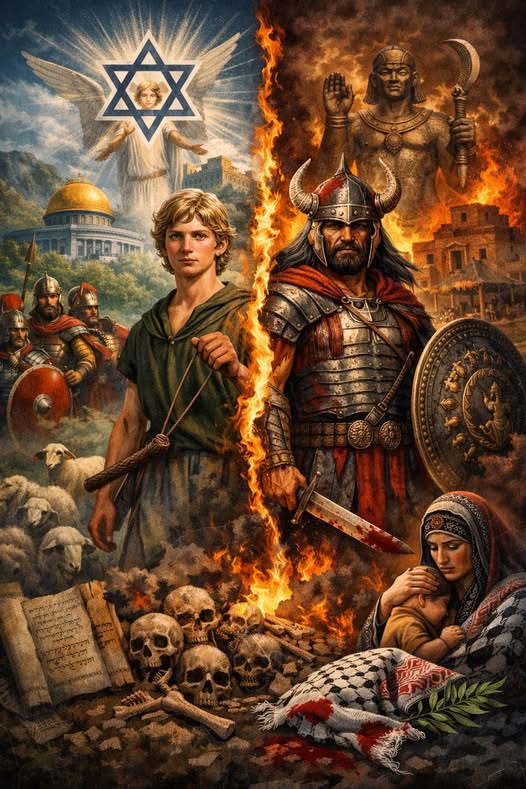
The film presents David as physically weak and unfit for combat—slender, short, with blond hair and blue eyes. According to certain interpretations of Canaanite belief systems, individuals with blond hair were sometimes viewed with suspicion, while blue-eyed individuals were considered unsuitable for night guarding due to perceived ضعف في الرؤية. However, the film frames David as an extension of the European white male archetype, aligning with fringe theories that claim the British royal family represents a surviving lineage of King David.
The costumes of all fighters in the film are characterized by a reddish-purple hue, commonly associated with Phoenician dye. Historically, Greek sailors wore black garments, Egyptian sailors wore white, while Phoenician sailors were known for their purple-red clothing—hence their name. They inhabited the eastern Mediterranean coast, from Jaffa in Palestine to Beirut in Lebanon, and dyed their textiles using secretions from the Murex sea snail.
The film heavily relies on what it presents as “Canaanite military attire,” claiming it to be the standard dress for all fighters—whether Israelite or Palestinian. This is historically inaccurate. Philistine warriors were distinguished by garments incorporating metal elements—arguably among the earliest forms of chest armor—combining linen, animal hides, and large metal plates fastened with leather straps over cloaks. In contrast, Canaanites wore embroidered, colorful cotton garments, layered with light leather cloaks, along with copper helmets adorned with gemstones and feathers. They carried large round shields made of metal alloys, decorated with symbols associated with the god El, the protector and guardian of Canaanite life. These shields were often lined with tough buffalo hide.
In a controversial narrative thread, the film introduces David’s mother, naming her Hannah bat Rafa, while also referring to her as Nitzevet bat Adael. It suggests that she learned wool-weaving techniques from the Moabites through her grandmother Ruth. Ruth the Moabite is indeed regarded as David’s great-grandmother; she married Boaz in Bethlehem after the death of her first husband and bore Obed, the father of Jesse, who was David’s father. The film depicts various wool-spinning techniques, from the loom to the spindle, while she narrates: “Every fabric has a story, and every human has a story,” echoing themes reminiscent of the Psalms of David.
The film also presents wool dyeing as involving a wide spectrum of colors—yellow, brown, red, blue, and others—yet this is not fully supported by historical evidence. Blue, for instance, was not widely favored in certain Canaanite contexts, where it was sometimes associated with underworld deities. Red, by contrast, was commonly linked to coastal populations such as the Philistines. Yellow was associated with silk and was not typically used unless the garment itself was made of silk. Canaanites were particularly known for wool dyes in green, violet, and grey tones, while floral sources were commonly used for dyeing linen textiles. Cotton garments, meanwhile, were often dyed indigo or left white, reflecting associations with Egyptian cultural influences.
Notably, the appearance of human figures woven into textiles—especially in the song of David’s mother—as well as depictions of ancient Egyptian pyramids, cannot be considered part of Canaanite, Palestinian, or early Israelite textile traditions. These elements are imaginative additions by the filmmakers and lack historical grounding. In Palestinian history, figurative artistic representation in textiles did not emerge before the Roman period in the early first century CE. Such imagery entered the region through Roman imperial iconography—portraits of emperors and military leaders—followed by pagan religious imagery associated with Roman deities. By the third century CE, early Christian iconography began to appear, depicting Christ, the Virgin Mary, and saints, primarily in churches and official buildings.
Further observations can be made regarding David’s costume in the film. He is depicted wearing the attire of a poor pastoral shepherd, made from coarse wool with wide pores—signifying poverty and life in a hot climate. This portrayal, however, contrasts with the film’s visual setting of lush, green mountainous landscapes rich in water resources. Additionally, the green decorative motifs on his garment include three symbols associated with the Canaanite deity Baal. In this context, inverted triangles symbolized agricultural fertility cycles, which were significant for farmers but not for nomadic shepherd communities. Moreover, the color green was associated with ascetic or plant-based lifestyles in certain ancient contexts, which does not align with David’s portrayal. Some traditions also linked green garments to enslaved individuals among Philistine societies, who were reportedly restricted from wearing red.
In conclusion, while the film may not be a direct product of organized campaigns to appropriate Canaanite or Palestinian heritage, it nonetheless advances a deeply problematic narrative. It implicitly justifies violence against Palestinians by portraying them as inherently savage, incapable of civilization, and unwilling to coexist peacefully with their neighbors—particularly the Israelites.