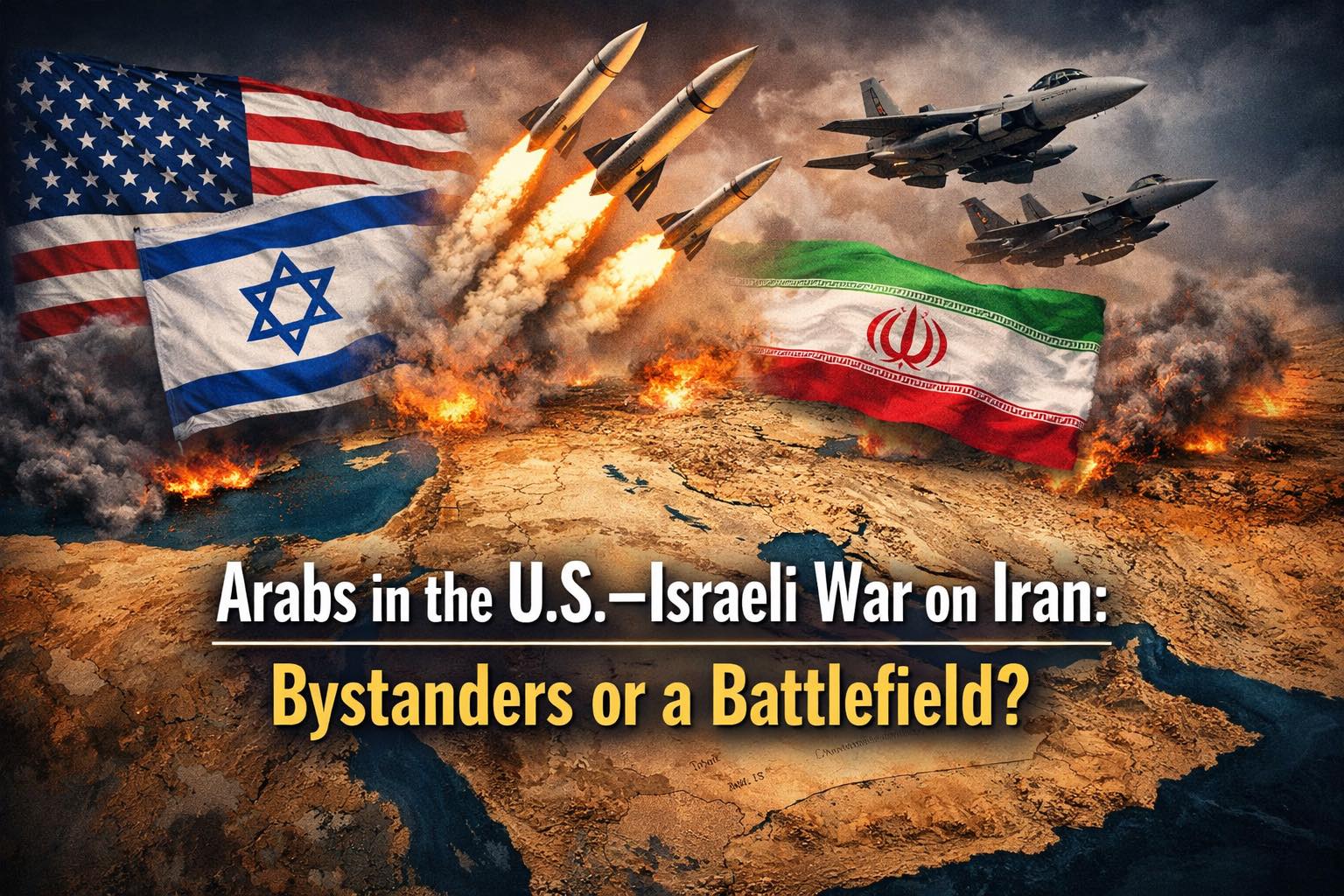
?Arabs in the U.S.–Israeli War on Iran: Bystanders or a Battlefield
By Khaled Ghannam
10/03/2026
:Introduction
Amid escalating military tensions, Arabs find themselves caught between two fires.
Missiles and warplanes fly over their lands, while major decisions are made far from them.
?Do they have a strategy to protect their interests, or are they mere bystanders
Many Arabs have emerged from the role of passive observers to navigate the complex maze of political alignments, after witnessing that U.S. military bases in Arab countries were not built to protect Arab nations, but to safeguard American interests in the Middle East. Protecting Israeli territories remains a top priority for the U.S. military, and the American administration consulted no one before initiating the war except the Israeli government.
It is difficult to confirm whether the U.S. military has used its bases in Arab countries to strike targets inside Iran. However, it is equally hard to imagine that these bases were not used for logistical and intelligence support for the attacking American forces. These bases were primarily established to counter Iranian threats to Arab countries and to protect U.S. interests in the region, especially Israel.
Analysts expect Iran to target Arab territories with missiles and drones for several reasons: the difficulty of reaching U.S. warships positioned far beyond the range of Iranian missiles without satellite guidance; the interception of many missiles and drones aimed at Israeli targets while over Arab territories, even when they posed no direct threat; and, according to Chinese and Russian media, retaliation against U.S. missile launch sites.
It has become evident that Arab countries lack any comprehensive emergency plans for managing crises. There are no clear evacuation plans for areas repeatedly under attack, no provisions to relocate civilians from high-risk zones to safer ones, no secure shelters within cities, and no protected routes for land, sea, or air transport.
Moreover, liberal economic policies make it difficult to maintain strategic reserves of food, medicine, water, and energy. Arab governments rely on open markets and domestic or international companies to supply resources continuously, without building a complete national security system for essential resources during crises, unlike many advanced nations or countries anticipating supply chain disruptions. This vulnerability is compounded by the fact that the region’s main maritime routes are under the control of Iranian and Houthi warships.
Public sympathy for Iran among Arabs has increased during the current conflict, fueled by frustration over the Arab response to the mass atrocities in occupied Palestine, especially Gaza. The U.S. administration is widely seen as providing military, political, and economic support to Israel, even amid repeated international condemnations of Israel’s discriminatory policies against Palestinians. Consequently, some Arab public opinion perceives Iranian missiles striking Israeli cities as part of rightful retaliation and calls for Arab support of Iran’s war against Israel and its U.S. ally.
Arab media has failed to convince audiences that the Iranian regime poses a greater threat than Israel, and some outlets have pushed the narrative of an Iranian-Israeli alliance against Arab peoples. This sectarian incitement, widely condemned across the Muslim world, fosters hatred by labeling Shia or Sunni as outsiders, posing one of the gravest threats to Arab and Islamic societies.
The greatest failure has been regarding the establishment of U.S. and European military bases in the Arab region, which have not provided adequate protection for Arab populations. Some military analysts note that American missile defense systems may intentionally cause debris from intercepted Iranian missiles to fall over Arab cities, despite the missiles’ intended targets being U.S. military sites or locations inside Israel.
By the end of the war, all parties— the United States, Israel, and Iran—will have achieved certain objectives. However, the goals of Arab countries remain unclear, especially as the U.S. administration and Israeli government assert that Arab states bear part of the operational costs.
The war’s conclusion will not come from overthrowing Iran’s regime without a U.S. ground invasion, implying a prolonged conflict. Iranian forces have demonstrated significant resilience and organizational flexibility despite leadership losses. Arab cities may face direct strikes if Iran perceives territorial losses or a dismantling of the Revolutionary Guard.
The Iranian regime has adapted to economic sanctions over the past forty years, establishing alternative supply chains and localizing military and civilian industries, which enhances its ability to withstand economic crises.
For Israel, the conflict has provided advantages ahead of upcoming elections, with increased public support for its policies and practical testing of new regional alliances, particularly in Syria, Turkey, and Lebanon.
The U.S. approach has also sought to impose new policies on alliances with friendly states, emphasizing self-reliance in defense, while allowing countries to increase weapons and ammunition supplies from U.S. factories during crises, contingent on Washington’s approval of each state’s defense plan.
The U.S. also aims to gain economic benefits from this war, including influence over global supply chains, particularly concerning Iranian oil, and securing investment stakes for American companies in exploration and production.
Many analysts do not expect the war to decisively resolve ongoing disputes between the parties. The Iranian nuclear file is not considered the true cause of the war, as experts question the existence of a direct nuclear threat to U.S. or Israeli interests.
Conclusion / Interactive Ending:
The path forward for Arab countries is clear: they must develop new policies, build strategic reserves of essential imports, and implement comprehensive emergency plans to face any renewed military escalation. Modern wars rarely end with total military victory; they require political and economic capability to manage crises and achieve gains without losing internal stability or regional influence.
What do you think?
?Do Arab countries have a clear strategy in this war, or are they merely bystanders