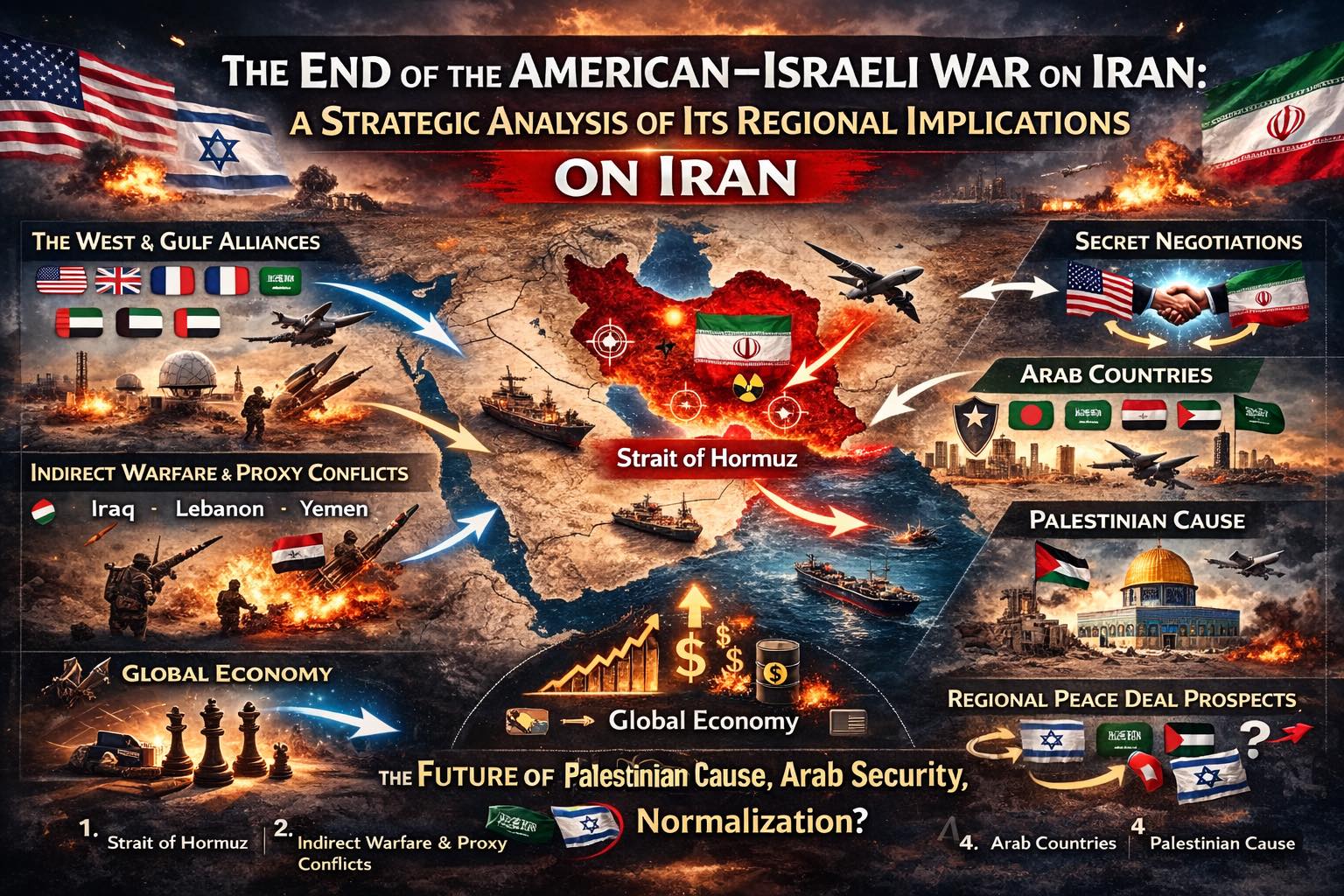
The End of the American–Israeli War on Iran: A Strategic Analysis of Its Regional Implications
By Khaled Ghannam – Australia
16/03/2026
Introduction
In recent years, the Middle East has witnessed an unprecedented escalation between the U.S. administration and Israel on one side, and Iran on the other, leading to wide-ranging military, political, and economic tensions.
This war has not been limited to direct confrontation; it has extended to international alliances, mutual defensive support, proxy wars, and secret negotiations.
This article aims to provide a comprehensive analysis of the war’s implications for Arab countries, the Strait of Hormuz, the Palestinian cause, and regional alliances, focusing on potential scenarios for the war’s end.
- Strait of Hormuz
The Strait of Hormuz is a global energy artery, through which most of the Gulf’s oil and gas exports pass.
The war has demonstrated Iran’s capability to disrupt navigation, directly affecting the global economy and raising oil prices [1].
- Indirect Warfare and Proxy Conflicts
- The West and Gulf States: Australia sent missiles and reconnaissance aircraft to support the UAE, while the United Kingdom, France, and Italy provided defensive support to Gulf forces [2].
- Iran’s allies: Militias in Iraq, Lebanon, and Yemen have been used to target U.S. and Israeli interests [3].
- Secret Negotiations
Despite the military escalation, secret diplomatic channels between the U.S. administration and Iran continue through regional and international mediators, aiming to de-escalate tensions and open a path for negotiation [4].
- Impact on Arab Countries and Populations
- The interception of Iranian missiles and drones has sparked wide public debates about the role of Arab governments [5].
- Some citizens view the interception as strengthening the alliance with the U.S. and Israel, while others see Iran’s attacks on infrastructure as justification for Arab–Western defensive alliances.
- The debris from missiles has raised public concern regarding civilian protection versus military interests [6].
- The presence of U.S. bases on Arab soil has become an additional defensive burden, with Arab armies participating in their protection as part of national defense.
- Impact on the Palestinian Cause
- There is no evidence of a direct change in Israeli control over the West Bank, Jerusalem, or Gaza.
- Palestinian public opinion is divided between sympathizing with pressure on Israel and the official stance opposing attacks on Arab civilians.
- Regional Peace Deal Prospects
Iranian threats or security cooperation against it may accelerate or reshape opportunities for normalization between Israel and some Gulf countries, such as Saudi Arabia, the UAE, and Qatar [7].
Conclusion
Current data suggests the war may end with a political settlement or continue as a multi-front attrition conflict involving proxy wars and diversified defensive support from the West and the Gulf.
It remains certain that any changes in regional alliances will affect the future of the Palestinian cause, Arab security, and normalization opportunities between Israel and Gulf states.
Question for the audience:
How do you see the role of Arab countries in this war? Should they focus solely on protecting their territories, or is their alliance with the U.S. administration and Israel defensibly justified?
Share your opinion on how this conflict affects the Palestinian cause and the region’s future.
⸻
References
- Reuters, 2026: https://www.reuters.com/…/us-is-quickly-exhausting…/…
- Al Jazeera, 2026: https://www.aljazeera.com/…/australia-to-send-missiles…
- The Guardian, 2026: https://www.theguardian.com/…/irans-regional-proxies…
- Al Jazeera, 2026: https://www.aljazeera.net/…/%D8%B9%D8%B4%D9%8A%D8%A9…
- Arab RT, 2026: https://arabic.rt.com/…/1763185-%D8%AF%D9%88%D9%84…/…
- Washington Post, 2026: https://www.washingtonpost.com/…/dubai-airport…/…
- Al Jazeera, 2025: https://www.aljazeera.net/…/%D9%81%D9%88%D8%B1%D9%8A%D9…