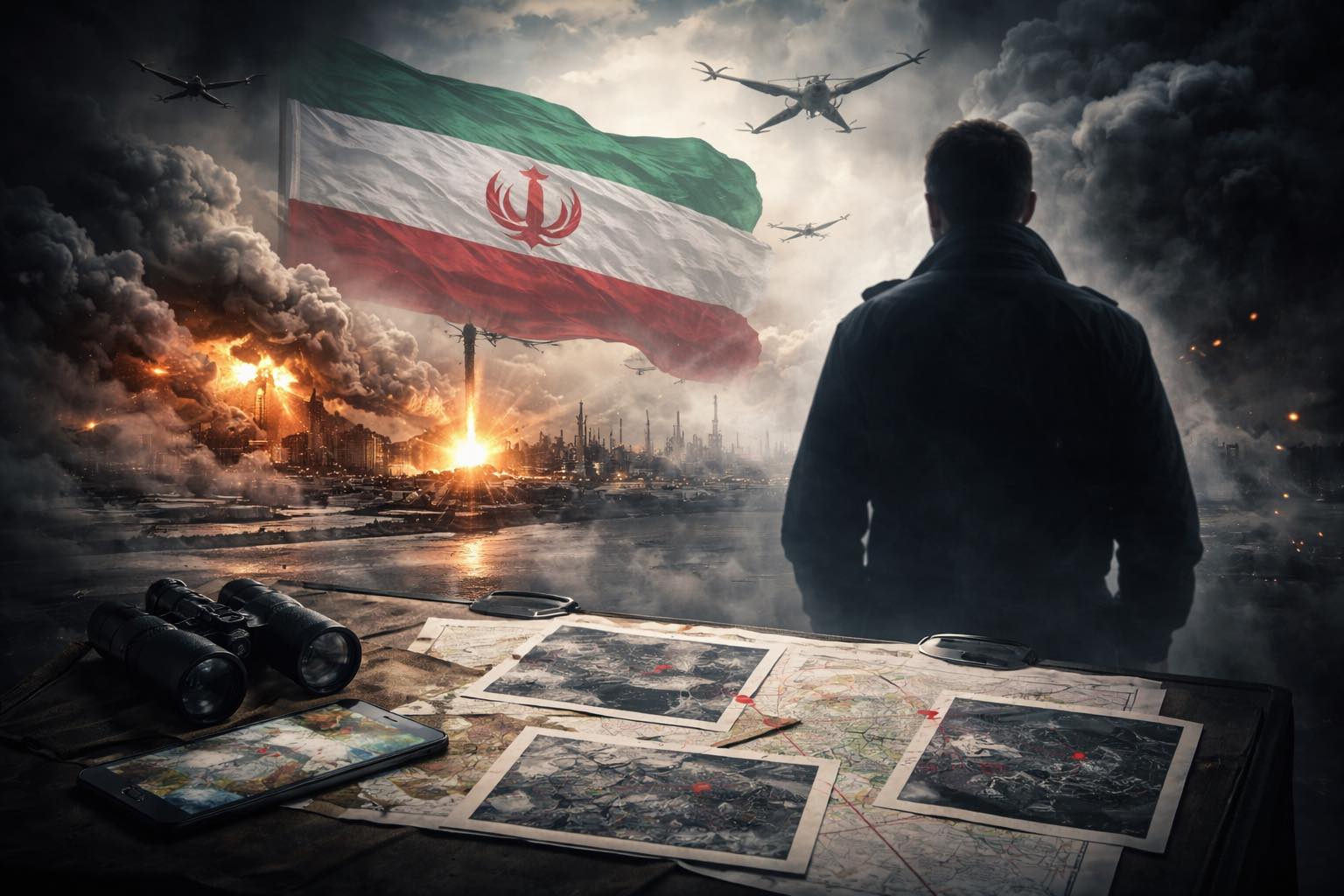
Plausible Deniability and the Shadow War With Iran
By Khaled Ghannam
23/03/2026
Introduction
Not all wars are declared. Not all strikes are claimed.
In the confrontation with Iran, a growing share of military and strategic activity unfolds without official acknowledgment. It is a form of conflict shaped by what remains unsaid—by actions executed under the logic of plausible deniability, where responsibility is obscured and accountability is deliberately blurred.
In such an environment, wars are not defined by public statements but by quiet operations. They are not framed through declarations, but through what all sides choose not to confirm.
As tensions rise, the battlefield has expanded far beyond traditional front lines. Today, it extends into information networks and digital platforms, where competing narratives circulate freely, and the line between fact and speculation becomes increasingly difficult to draw.
A War Without Attribution
Modern conflict is no longer defined by open confrontation alone. As analysts at institutions such as RAND Corporation and Chatham House have noted, contemporary warfare operates across multiple domains—military, economic, and informational.
In this environment, social media has become a powerful amplifier of uncertainty. Unverified claims, partial accounts, and speculative reports often circulate faster than verified information, shaping perceptions before facts are established. This dynamic complicates public understanding and places a premium on critical scrutiny.
At the same time, political actors operate within carefully managed boundaries. The Iranian opposition, particularly figures based abroad, remains visible in political and media discourse. However, there is little evidence to suggest a direct operational role in ongoing military activity. Meanwhile, international actors continue to favor indirect pressure over direct confrontation, seeking to avoid escalation into full-scale war.
Managing the Balance of Power
Current indicators suggest that the objective is not regime change through military force, but rather the containment and management of Iranian influence—a view echoed in analyses from the Brookings Institution.
Nowhere is this more evident than in Syria, where overlapping regional and global interests have created one of the most complex theaters of competition in recent history. No single actor holds decisive control, and the result is a persistent, fragile equilibrium shaped by shifting alliances and competing objectives.
The Gulf and Global Stakes
The Arabian Gulf remains central to this fragile balance. Home to key energy routes—most notably the Strait of Hormuz—the region plays a critical role in the stability of global markets.
According to the International Energy Agency, even limited disruption in this corridor could trigger immediate consequences for global energy prices and economic stability.
For regional states, stability is not merely a political goal—it is an economic necessity. Despite differences in approach, countries such as Saudi Arabia and the United Arab Emirates share a common interest in preventing escalation and safeguarding energy flows.
Diplomacy in the Background
Amid these tensions, diplomacy continues to operate quietly in the background. Countries such as Oman and Switzerland have long played roles as intermediaries, facilitating indirect communication and preserving channels that might otherwise be closed.
These efforts, though often understated, are essential. They reduce the risk of miscalculation and help maintain space for de-escalation in an increasingly volatile environment.
Economic Uncertainty
The economic dimension of this conflict is impossible to ignore.
Sustained tensions increase volatility across global markets, particularly in the energy sector. Investors and governments alike face growing uncertainty, as the risk of disruption to supply chains and trade routes remains ever-present.
The result is a global economy operating in a state of heightened sensitivity—reacting not only to events themselves, but to the possibility of events.
A New Kind of Conflict
What emerges from this landscape is a transformation in the nature of war itself.
Conflict is no longer confined to the battlefield. It is fought in the realm of perception, narrative, and information control. The struggle is not only over territory or influence—but over how events are understood, framed, and remembered.
Within this framework, plausible deniability and unsignaled operations form a strategic language of their own. Actions are carried out with precision, yet without attribution. Responsibility is diffused, and escalation is carefully calibrated.
The Unanswered Question
The central question remains unresolved:
Does this evolving model of conflict point toward a more stable equilibrium—anchored in deterrence and restraint?
Or does it signal a deeper shift toward prolonged ambiguity, where conflicts persist in the shadows, unresolved and unacknowledged?
What is clear is that the rules of engagement are changing. And with them, the future of the region is being shaped—not only by what is done, but by what is left unsaid.