From Theory to Practice: What Can the Left Learn from Chantal Mouffe’s Idea of Left Populism?
By Khaled Ghannam – Australia
There is no doubt that Chantal Mouffe is an important and creative left-wing thinker who has written several influential books on political theory. I find it surprising that some left-wing activists in Australia have never heard of her or her work. Of course, I will not mention any names!
In this article, I do not want to write a summary or review of Mouffe’s book For a Left Populism (2018). Instead, I want to explore some of the ideas in her work and ask how the left can learn from them and use them as practical tools in its political activities.
I believe that the left needs to think seriously about the way it communicates with people, builds movements, creates political alliances and presents an alternative to the existing political and economic system. Mouffe’s ideas offer some useful ways to think about these challenges.
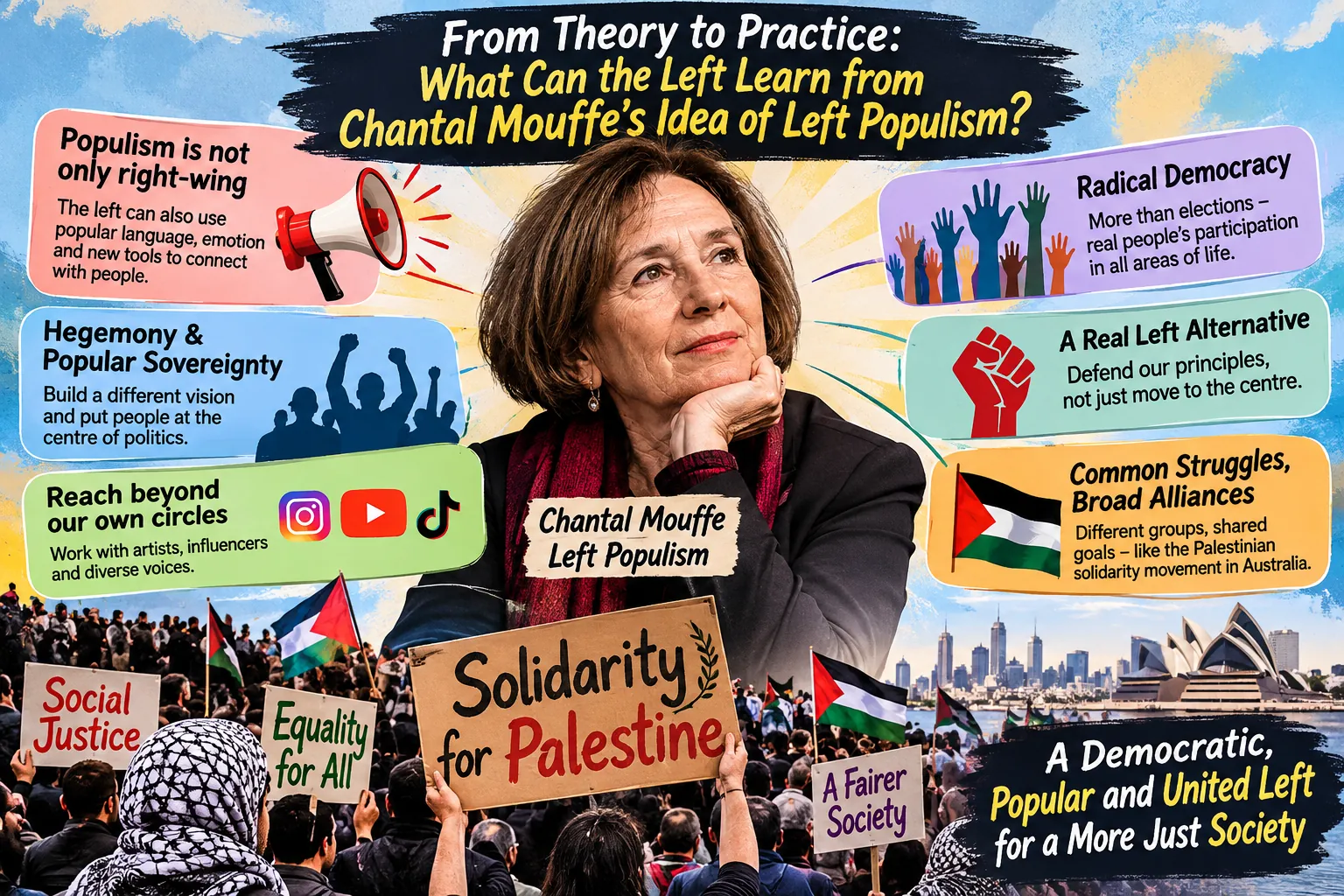
Populism is not the property of the right
One of the first things we need to understand is that populism is not automatically right-wing. The far right has learned to use popular language, emotional political messages, social media and public anger very effectively. But this does not mean that these tools belong to the right.
The left should not be afraid of new political tools simply because the far right has learned to use them effectively. The important question is whose political interests these tools serve and what kind of society we want to build.
However, left populism is about more than using popular language or improving political communication. As Mouffe explains in For a Left Populism, it is a political strategy for constructing a collective identity – a people – by connecting different social demands and drawing a political boundary between the people and those who hold economic and political power.
Left populism is about communicating with ordinary people in a direct and understandable way. It means using political language that connects with people's experiences, hopes, fears and daily problems. It also means challenging ourselves and believing that we can change situations that may appear impossible, even when we do not have the same financial resources or political power as the economic and political elites.
Our strength should come from people organising together. When people unite around common demands, they can build pressure on political institutions and force political leaders to respond.
However, popular support alone is not enough. The left needs to connect people's demands with a clear political project based on equality, social justice, solidarity and democratic participation.
Hegemony and popular sovereignty
Two important ideas in Mouffe's political thinking are hegemony and popular sovereignty. Her understanding of hegemony is strongly influenced by the Italian Marxist thinker Antonio Gramsci.
Hegemony is about the struggle to shape people's political ideas and influence what society sees as normal or acceptable. It is not enough for the left to criticise the existing political and economic system. It must also present a different vision for society and work to build public support for that vision.
This means that political change is not simply about winning elections or replacing one government with another. It also involves changing the ideas, values and assumptions that shape society's common sense.
Popular sovereignty means that the people are the source of political power and legitimacy. Political leaders and institutions should serve the people, listen to their demands and be accountable to them. Democracy should not be limited to voting in elections. People should also have a real voice in decisions that affect their lives.
For the left, these ideas raise an important question: how can we move from simply opposing government policies to building an alternative political and social project that can win the support of a wider part of society?
Reaching people beyond our own political circles
Another important tool of modern political communication is the use of social media influencers to spread political ideas and reach a wider audience.
These influencers do not necessarily have to be left-wing activists or members of political organisations. They may be artists, cultural figures, writers or people who are popular in different fields.
We may find common ground with them on certain issues and work together to promote these ideas. Political movements can also pay influencers to promote their messages, as some right-wing populist actors do. If we use paid promotion, it should be transparent and clearly identified as such.
The left should not limit its political communication to its own activists and supporters. It needs to find new ways to reach people who may not normally follow political organisations or attend political meetings and demonstrations.
The challenge is to make left-wing ideas part of everyday public discussion, including through culture, art, social media and other forms of communication.
The relationship between liberalism and democracy
Another difficult issue is the relationship between liberalism and democracy, and the debate within the left about working with liberal political groups.
Many left-wing activists are reluctant to cooperate with liberals, except when authoritarian political forces threaten democratic freedoms and institutions.
This raises an important question: should cooperation between the left and liberals only happen when democracy is under threat, or can we also work together on issues where we share common goals, while maintaining our political differences?
Mouffe's argument invites us to think about this relationship more carefully. Defending liberal democratic institutions does not mean accepting neoliberal economic policies. At the same time, challenging those policies does not require rejecting democratic institutions and freedoms.
The left needs to understand that political differences do not always prevent cooperation. There can be common ground on particular democratic and social issues, even when there are serious disagreements on other matters.
The need for radical democracy
One of the more difficult ideas in Mouffe's work is the proposal for radical democracy.
In simple terms, radical democracy means going beyond the idea that democracy is only about elections and choosing political representatives. It means expanding democracy into different areas of society and giving people more power to participate in decisions that affect their lives.
This includes workplaces, economic decisions, public services and local communities. It also means taking equality and freedom seriously, rather than treating them as promises that end after election day.
For the left, this means that democracy should not only be something we defend against authoritarianism. It should also be something we expand and strengthen through people's everyday participation and collective action.
Finding a real left-wing alternative: The crisis of the centre-left
Another important question is the need to rebuild a clear and genuine left-wing alternative, rather than accepting the idea that the left must always move towards the political centre.
One of Mouffe's important arguments is that the centre-left cannot simply restore its political influence by returning to more moderate social policies. She argues that many social-democratic parties have become part of the neoliberal consensus rather than offering a real alternative to it.
In her interview with Verso, "We urgently need to promote a left-populism", Mouffe explains how the response of social-democratic parties to the 2008 financial crisis demonstrated their inability to challenge the neoliberal consensus.
By moving towards the political centre and accepting many of the basic assumptions of neoliberalism, they have weakened the traditional distinction between left and right. This has also created political space for the far right to present itself as the only force challenging the establishment.
Mouffe argues that the left needs to move beyond this consensus and build a new political project capable of challenging neoliberal hegemony, rather than simply trying to manage it more humanely. She develops this argument further in Left Populism and Taking Back Democracy.
The left should not be afraid to defend its principles and present a clear political alternative. Trying to become acceptable to the political centre can sometimes lead left-wing parties to weaken their positions and move away from the interests of working people.
The challenge is not simply to win elections by moving closer to the centre. It is to rebuild a strong left-wing movement that can offer real changes, challenge economic and political power, and give people a reason to believe that another society is possible.
This does not mean rejecting every compromise or every political alliance. It means that cooperation and compromise should not become an excuse for abandoning the political identity and goals of the left.
The Palestinian solidarity movement in Sydney: A practical example
The Palestinian solidarity movement in Sydney provides a practical example of how different political and social groups can work together around a common struggle while maintaining their own identities and organisational independence.
The Palestine Action Group Sydney brings together people from different backgrounds and political tendencies through joint demonstrations and other collective activities. These include left-wing activists, Islamic groups, trade unionists, students, human rights activists, Palestinian community organisations and many others.
However, this cooperation does not mean that all groups operate within one organisation or abandon their own activities. Each group continues to organise its own events and campaigns according to its particular interests and priorities.
For example, Islamic groups organise their own activities, trade unions organise workplace campaigns and solidarity actions, and student organisations organise activities within universities. Left-wing organisations also maintain their own political activities and campaigns.
This can be seen in the independent activities of Unionists for Palestine and Students for Palestine, alongside joint demonstrations organised by the Palestine Action Group.
This creates two complementary forms of political activity: collective action around shared demands and independent organising by different groups.
These groups do not necessarily share the same political views or agree on every issue. Some may have very different positions on social, religious, economic and political questions.
However, they can work together because they share a common position on Palestinian rights and the need to stand against the oppression of the Palestinian people.
I believe this experience offers an interesting practical example of Mouffe's idea of building a collective political identity through shared demands. It can also be understood through the concept of a chain of equivalence, in which different groups connect their particular demands around a common political struggle without losing their own identities.
This is also related to Mouffe's idea of agonistic pluralism. Political differences do not have to disappear for people to work together. Rather, different groups can recognise their differences while participating in a common democratic space.
The important lesson is that unity in action does not require organisational unity. We do not need to agree on everything before we can take collective action.
Of course, working together on one issue does not mean that all groups must abandon their own political identities or agree on every other issue. The aim is to build solidarity around shared demands while respecting political differences.
From mobilisation to building a movement
There is also an important difference between mobilising people for an event and building a lasting political movement.
Social media campaigns, public demonstrations, emotional messages and broad alliances can bring people together. But these activities need to become part of a wider process of political education, organisation and collective action.
The experience of Palestine solidarity in Sydney shows that joint demonstrations and independent activities can exist alongside each other. Different groups can contribute to a common struggle while continuing to organise their own members and communities.
This raises an important question: how can temporary mobilisation become a lasting political movement?
The left needs to turn public anger into organised demands, temporary cooperation into lasting solidarity, and popular support into real democratic participation.
Mouffe's ideas encourage us to think about how different struggles can become part of a wider political project. This is not about making everyone think in the same way. It is about building a common direction while recognising differences.
Conclusion
The main lesson I take from Chantal Mouffe's idea of left populism is that the left needs to rethink the way it communicates, organises and builds political alliances.
It should not leave popular political communication to the far right. It should use modern tools, reach people beyond its traditional circles, build common ground with different social groups and present a clear alternative based on equality, freedom and social justice.
At the same time, the left needs to challenge the neoliberal consensus rather than simply trying to manage it more humanely. It needs to build a political project capable of changing the balance of power and creating a new democratic and social hegemony.
The experience of Palestine solidarity in Sydney shows that people with different political and social views can come together around a common cause without abandoning their organisational independence or political identities. This experience can offer lessons for other struggles and for the future of the left.
We should not be afraid of new political tools simply because others are using them. We should understand them, develop our own methods and use them to strengthen solidarity, popular participation and collective political action.
The question for the left is not simply whether it should use populist tools. The real question is how it can build a broad democratic movement capable of challenging existing power structures and changing society.
Further reading: Khaled Ghannam's Arabic translation of For a Left Populism, with a critical reading, political glossary and a profile of Chantal Mouffe (2026).